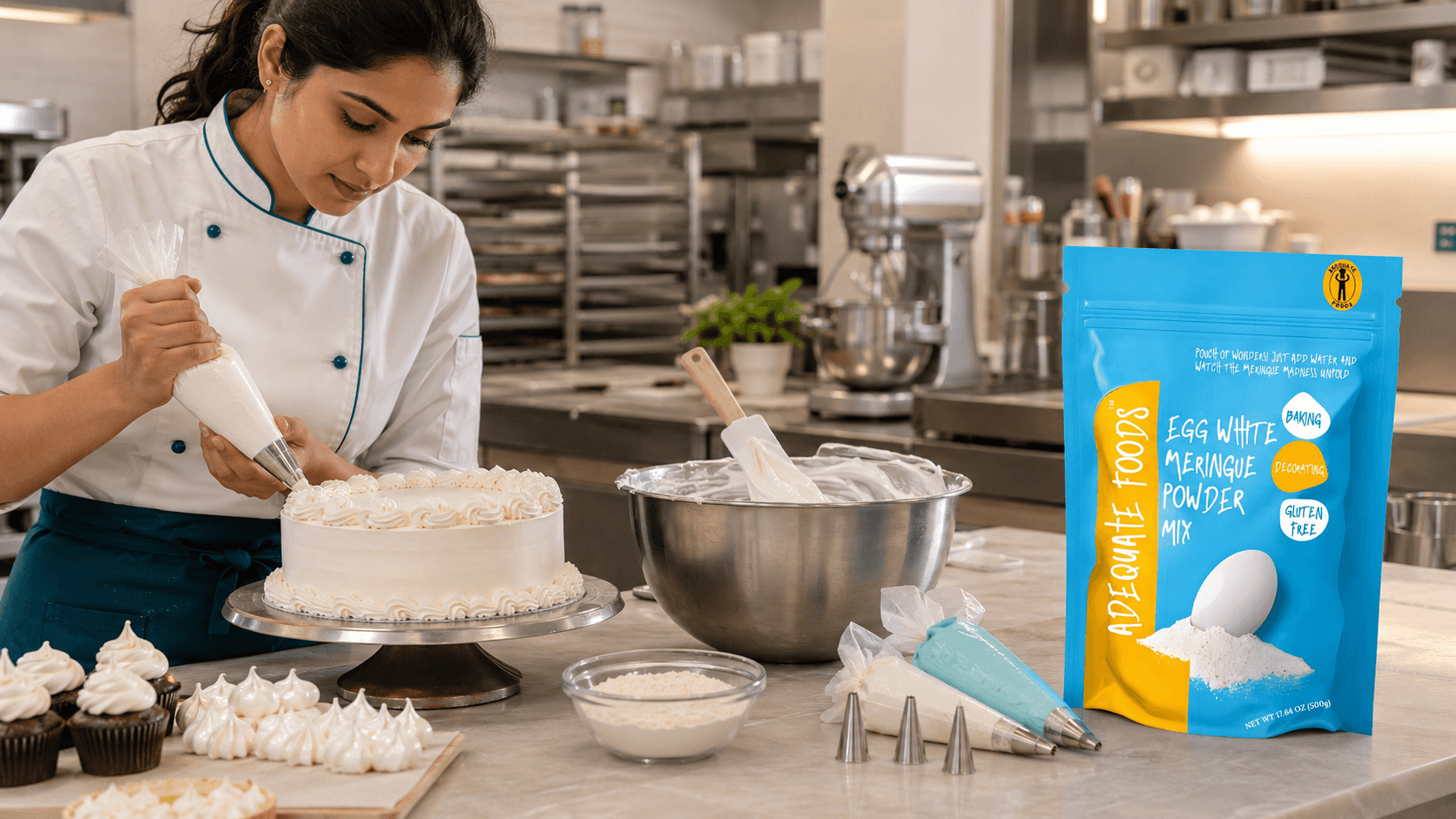
Using Meringue Mix for Royal Icing
How meringue mix simplifies royal icing preparation for cookie decorating and piping work.

KEY TAKEAWAY
Royal icing is the standard medium for cookie decoration, piping borders and flood work. Meringue mix provides a reliable, food-safe base for royal icing that dries to a smooth, hard finish.
What Royal Icing Is
Royal icing is a mixture of egg white (or meringue powder), powdered sugar and a small amount of liquid. When mixed and applied to cookies or other baked goods, it dries to a hard, smooth, matte finish that can be piped, flooded or used for detailed decorative work.
Unlike buttercream or ganache, royal icing sets firm and remains stable at room temperature, making it the preferred medium for decorated cookies that need to be shipped, stacked or displayed.
Meringue Mix as a Royal Icing Base
Traditional royal icing uses raw egg whites, which introduces food safety concerns — particularly for products that will not be baked after decorating. Meringue mix, made from pasteurised egg white, eliminates this concern while providing the same functional protein base needed for icing structure.
The stabilising components in meringue mix can also benefit royal icing by improving its workability and consistency during piping, and by supporting a smoother dried surface.
Preparation Method
Combine meringue mix with water and whisk until frothy. Gradually add sifted powdered sugar, mixing on low speed until the sugar is incorporated, then increasing speed to develop the icing to the desired consistency.
For outlining and piping details, the icing should hold a firm peak and a line piped from the nozzle should maintain its shape. For flooding (filling an outlined area with smooth, level icing), the consistency should be thinner — a drop of icing should settle back into the surface within a few seconds.
Working Tips
Royal icing begins to dry as soon as it is exposed to air. Keep unused icing covered with a damp cloth or sealed in piping bags to prevent a skin from forming on the surface. If the icing becomes too thick during use, a small amount of water can be mixed in to restore workability.
Colour is added using gel or powder food colours — liquid colours add too much moisture and can affect the icing's drying behaviour. Allow flooded icing to dry fully before adding additional layers or details to prevent bleeding between colours.
MORE FROMTHE LAB.
Continue exploring the science, applications and possibilities behind modern egg ingredients.