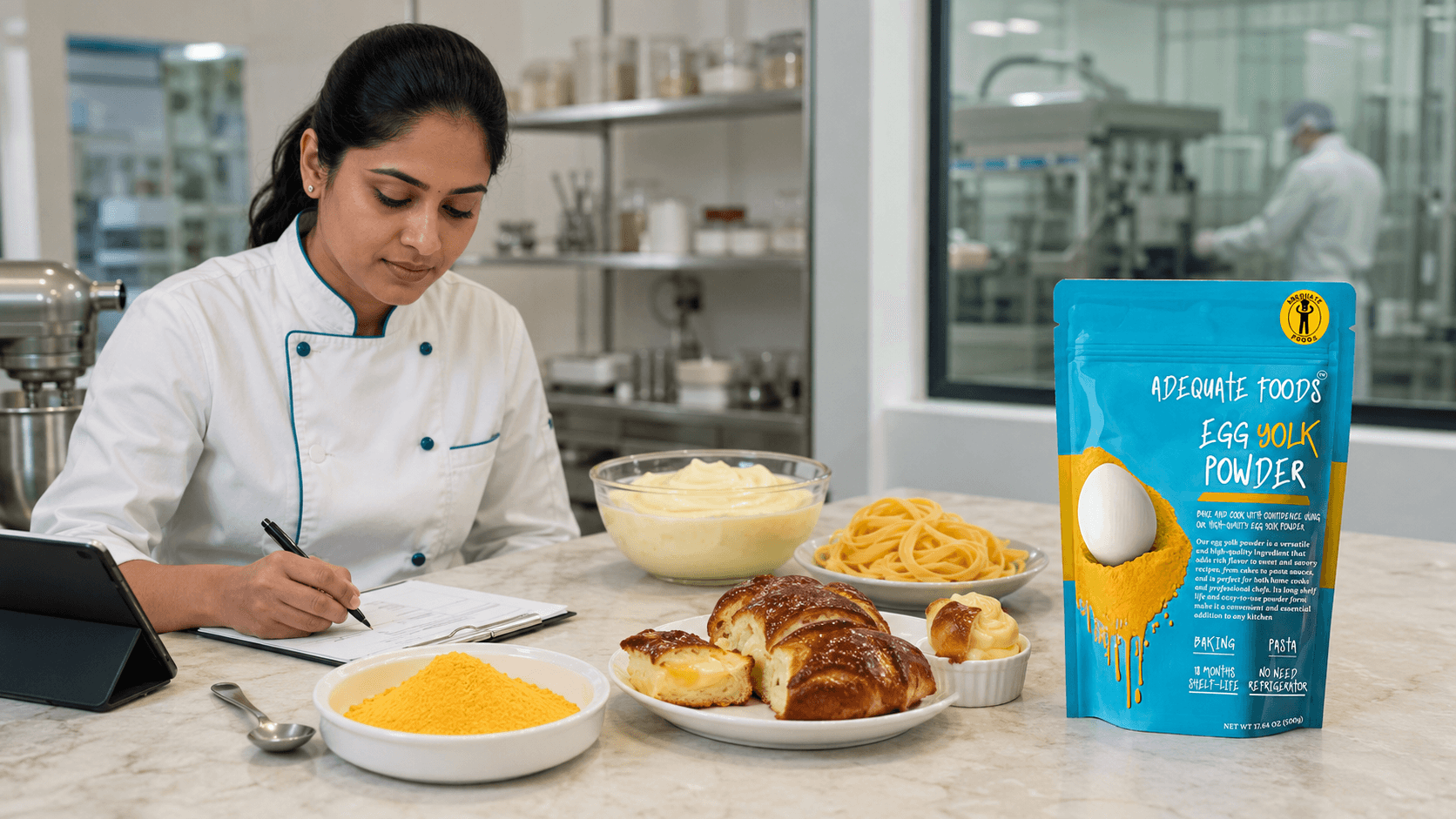
What Is Whole Egg Powder? A Practical Guide
A clear introduction to whole egg powder — what it is, how it is made, and where it fits in modern cooking and food production.

KEY TAKEAWAY
Whole egg powder is a spray-dried ingredient made from pasteurised whole eggs. It preserves the natural balance of yolk and white proteins, enabling use across baking, cooking and food manufacturing where fresh eggs would traditionally be required.
What Whole Egg Powder Is
Whole egg powder is produced by breaking fresh shell eggs, blending the yolk and white together, pasteurising the liquid mixture, and then spray-drying it into a fine powder. The process removes nearly all moisture while preserving the proteins, fats, vitamins and minerals naturally present in a whole egg.
The resulting powder is shelf-stable, compact and functionally versatile. When reconstituted with water, it approximates the behaviour of fresh beaten eggs in most cooking and baking applications — providing binding, leavening, emulsification and colour.
How It Is Made
Production begins with fresh eggs sourced from approved farms. The eggs are mechanically broken and the liquid is filtered to remove shell fragments. The blended liquid egg is then pasteurised — heated to a temperature and time combination sufficient to eliminate harmful pathogens while preserving protein functionality.
After pasteurisation, the liquid is fed into a spray dryer, where it is atomised into fine droplets and exposed to hot air. The water evaporates rapidly, leaving behind dry egg solids that are collected, sifted and packaged. The entire process is conducted in food-grade facilities under strict hygiene and quality controls.
Where Whole Egg Powder Is Used
The applications for whole egg powder span home kitchens, professional foodservice and food manufacturing. In home kitchens, it serves as a convenient pantry staple for baking, breakfast preparation and any recipe calling for eggs. In professional kitchens, it reduces the labour, waste and storage challenges associated with managing large volumes of shell eggs.
In food manufacturing, whole egg powder is an established ingredient in products ranging from pasta and baked goods to sauces, dressings and processed foods. Its shelf stability, consistent composition and ease of handling make it well suited to industrial production environments.
Reconstitution Basics
To use whole egg powder as a substitute for fresh eggs, it is mixed with water at a ratio specified by the manufacturer. The exact ratio depends on the product's composition and the intended application. After mixing, the reconstituted egg should be used promptly, following the same handling practices as fresh beaten eggs.
For best results, use lukewarm water and whisk thoroughly to ensure complete hydration of the powder. Lumps indicate incomplete mixing and may affect performance in the recipe.
Practical Advantages
The core advantages of whole egg powder are consistency, convenience and shelf stability. It eliminates the variability inherent in shell eggs — no more worrying about egg size, freshness or cracking quality. It simplifies procurement and storage by replacing a refrigerated perishable with a dry, ambient-stable ingredient. And it reduces waste, since only the required amount is reconstituted and used.
These advantages are most pronounced in high-volume operations and in settings where refrigeration capacity or reliable fresh egg supply is limited — including remote kitchens, mobile catering, expedition cooking and emergency food supply.
MORE FROMTHE LAB.
Continue exploring the science, applications and possibilities behind modern egg ingredients.