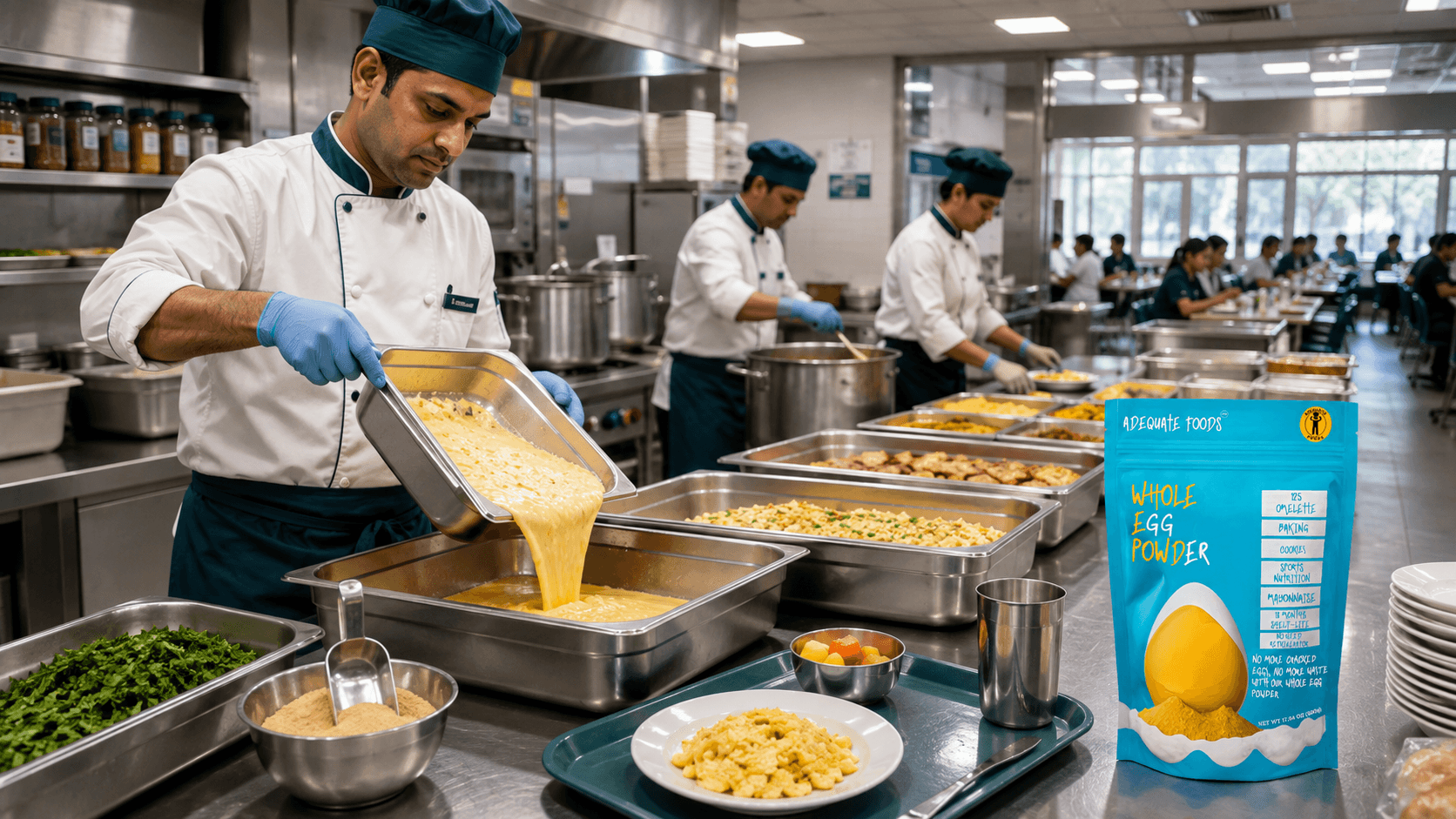
Working with Egg White Powder in Foodservice Kitchens
Practical guidance on integrating egg white powder into professional foodservice kitchen workflows.

KEY TAKEAWAY
Foodservice kitchens — hotels, restaurants, catering companies and contract feeders — face unique operational demands. Egg white powder can simplify ingredient management, reduce waste and support consistent output across diverse menu applications.
Foodservice Kitchen Realities
Professional foodservice kitchens are high-pressure environments where speed, consistency and cost control are constant priorities. Menus change frequently, covers vary unpredictably, and ingredient waste has a direct impact on food cost percentages.
In this context, the practical advantages of egg white powder — ambient storage, precise measurement, no cracking labour, no spoilage risk — align well with foodservice operational needs.
Common Foodservice Applications
In hotel and restaurant kitchens, egg white powder finds use across multiple stations. The pastry section uses it for meringues, soufflés and egg-wash applications. The cold kitchen uses it for cocktail preparations and garnishes requiring foam. The hot kitchen may use it for binding or coating applications where fresh egg whites would otherwise be required.
Buffet operations, where volume is high and consistency is essential, particularly benefit from the uniformity that egg white powder provides. A breakfast buffet producing omelettes, pancakes and baked goods simultaneously can standardise its egg white usage across stations without managing separate fresh-egg inventories for each.
Inventory and Waste Reduction
One of the less visible but financially significant advantages of egg white powder in foodservice is waste reduction. Fresh egg whites that are separated but unused spoil quickly. Shell eggs nearing their use-by date must be consumed or discarded. Breakage during transport and handling adds to loss.
Egg white powder eliminates these waste streams. It is portioned as needed, with the remainder sealed and returned to dry storage. There is no race against expiry dates, no loss from breakage and no disposal cost for unused product.
Training and Skill Requirements
Foodservice kitchens often operate with teams of varying skill levels, and staff turnover can be high. Egg white powder simplifies the egg-handling step in recipe preparation, reducing the skill threshold for consistent results.
A clearly documented reconstitution procedure — specifying powder weight, water volume, water temperature and mixing method — can be followed reliably by kitchen staff with basic training. This standardisation supports quality consistency even as team composition changes.
Integration Considerations
Kitchens introducing egg white powder for the first time should start with applications where the functional requirements are clear and the current fresh-egg process is a known pain point. Once the team is comfortable with reconstitution and usage in familiar recipes, the ingredient can be extended to additional applications based on results.
Allergen labelling obligations apply to all menu items containing egg white powder, just as they do for fresh eggs. Kitchen teams must ensure that egg-containing dishes are properly identified in allergen matrices and customer-facing communications.
MORE FROMTHE LAB.
Continue exploring the science, applications and possibilities behind modern egg ingredients.