Whole Egg Powder vs Shell Eggs: Understanding the Difference
A practical comparison of whole egg powder and fresh shell eggs across the factors that matter in real kitchens.
KEY TAKEAWAY
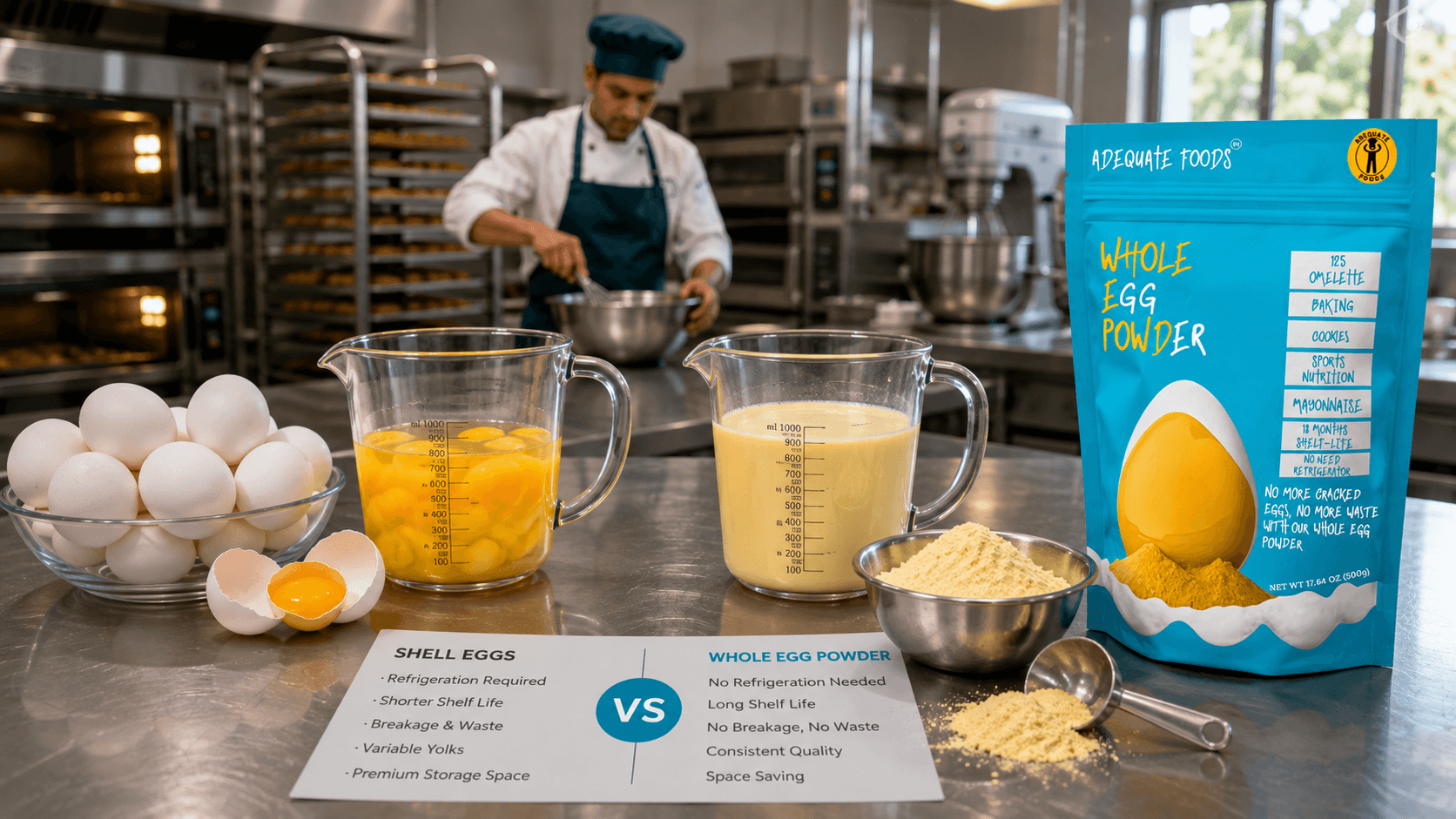
Both whole egg powder and shell eggs deliver the same core functionality — binding, leavening, emulsification and colour. The differences lie in handling, consistency, shelf life, waste and cost structure.
Starting from the Same Place
Whole egg powder and shell eggs are not different ingredients — they are different formats of the same ingredient. Whole egg powder is made from fresh eggs, with only the water removed. The proteins, fats, vitamins and minerals are preserved, and the functional behaviour in cooking and baking is broadly equivalent.
The meaningful differences between the two formats are practical, not compositional. They relate to how each is stored, handled, measured and managed in day-to-day kitchen operations.
Consistency
Shell eggs vary naturally. Egg size, yolk-to-white ratio, shell thickness and internal quality all fluctuate depending on the hen's breed, age, diet and the farm's management practices. For home cooking, this variation is usually inconsequential. For commercial production, where recipes are scaled to hundreds or thousands of units, it introduces unpredictability.
Whole egg powder eliminates this variation. Each gram of powder delivers the same protein and fat content, enabling precise, repeatable formulations that produce uniform products batch after batch.
Shelf Life and Storage
Shell eggs require refrigeration and have a usable life typically measured in weeks. They are fragile, bulky relative to their content, and subject to breakage during transport and handling.
Whole egg powder stores at ambient temperature in sealed packaging, with a shelf life measured in months. It is compact, lightweight and resistant to damage. For operations with limited refrigeration capacity or unpredictable demand patterns, this difference can significantly simplify inventory management.
Waste and Cost
Egg waste in a commercial kitchen comes from multiple sources: eggs that expire before use, eggs that break during handling, yolks or whites that are separated and unused, and shells that must be disposed of. With whole egg powder, waste sources are reduced to near zero — only the exact amount needed is reconstituted.
Total cost comparison should account for purchase price per unit of usable egg solids, not per unit of packaged product. When waste, labour, refrigeration and disposal costs are included, the cost equation often favours powder in medium-to-high volume operations.
Where Each Format Fits
Shell eggs are the right choice when their specific qualities are valued — the visual appeal of whole eggs in a display kitchen, the ritual of cracking eggs for a breakfast show station, or the particular texture of eggs cooked immediately after separation.
Whole egg powder is the right choice when the priorities are consistency, convenience, reduced waste, shelf stability and operational simplicity. Many professional kitchens use both formats strategically, selecting the one that best suits each specific application.
MORE FROMTHE LAB.
Continue exploring the science, applications and possibilities behind modern egg ingredients.